



R&I vs. R&R: What Those Collision Estimate Terms Actually Mean
Auto Repair Tips

When you receive a collision repair estimate, most of the terminology is fairly easy to recognize. You can understand “bumper,” “fender,” “headlamp,” or “refinish.” Then you come across R&I and R&R, and the estimate suddenly looks like a different language. The terms are simple once you know what they mean. R&I stands for Remove and Install. R&R stands for Remove and Replace. CCC uses these abbreviations in its estimating system to distinguish between removing an existing component and putting that same component back on, versus removing it and installing a replacement. What matters to a vehicle owner is what those operations mean in practice. An R&I line can involve a part that was never damaged. An R&R line means the original component won’t go back on the vehicle. Once that distinction is clear, collision estimates become much easier to follow.
What Does R&I Mean on a Collision Estimate?
R&I means Remove and Install. The technician removes the existing component and installs it again later. The part may be completely usable. It may simply need to be removed so the technician can reach the damaged area behind it, protect the component during another repair operation, or gain enough access to complete the job correctly.
For example, a bumper cover might need to come off so technicians can inspect or repair components underneath it. If the bumper cover is still suitable for use, technicians reinstall the same cover after the work is complete. That is an R&I operation.
This distinction matters because R&I does not mean the part is repaired or replaced. It describes what happens to the component during the auto repair process.
What Does R&R Mean on a Collision Estimate?
R&R means Remove and Replace. The original component is removed, and a replacement is installed. A damaged fender, for example, may be written as R&R when the repair plan calls for a replacement rather than restoring the original panel. The estimate may then include the replacement part along with the labor and related operations needed to install it.
The abbreviation tells you what is happening, but not necessarily why the replacement is required. That reason could be collision damage, the component’s construction, a manufacturer repair restriction, or another condition that makes the original part unsuitable for reuse.
So the simplest way to remember the difference is:
R&I: The same part comes off and goes back on.
R&R: The original part comes off, and a replacement takes its place.
One Collision Repair Can Include Both
R&I and R&R are not competing approaches. A single repair can involve both operations.
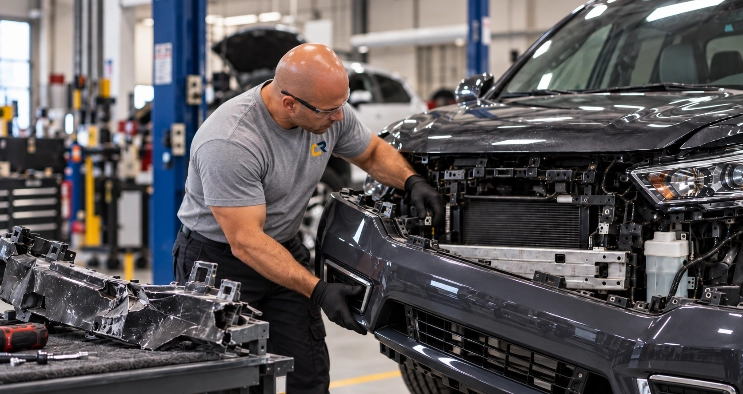
Consider a vehicle with front-end damage. The bumper cover may need to be removed to access the components behind it, then reinstalled once the work is finished. That would be R&I.
If a damaged component underneath the bumper cannot be reused, it may be removed and replaced with another part. That would be R&R.
That is why an estimate can include several different operations in the same area of the vehicle. The estimate documents the work needed to complete the repair, not just the parts that appear damaged from the outside.
For a broader look at why collision estimates can change as a vehicle is inspected and repaired, see our guide on how collision repair estimates can change during the repair process.
Why Would a Collision Repair Shop R&I an Undamaged Part?
This is probably the most common reason customers question an R&I line.
Collision damage often involves several layers of the vehicle. A technician may not be able to reach the damaged component without first removing another part that is perfectly fine. Working around it may limit access or prevent the technician from repairing as intended.
I-CAR explains that parts may need to be removed to gain access to damaged areas and allow repairs to be performed properly.
That means an R&I operation can be necessary even when the part being removed shows no collision damage.
Think of it as access labor rather than damage labor. The component is temporarily in the way of the repair, so it comes off and goes back on when the work behind it is finished.
Does R&R Always Mean the Collision Damaged the Part?
No.
Visible collision damage is one reason for replacement, but it is not the only one. Some vehicle components or fasteners are designed for one-time use. Others may have specific manufacturer requirements that determine whether they can be reused after removal.
That can lead to a situation where a component looks perfectly normal but still does not return to the vehicle. The absence of visible damage does not automatically make a part suitable for reuse.
This is why it helps to separate two questions when reading an estimate:
What operation is being performed?
That is where R&I or R&R comes in.
Why is that operation required?
That comes from the part’s condition, the repair method, and, when applicable, the manufacturer’s procedures.
The abbreviation provides the first answer. The collision repair plan provides the second.
Does an R&I Line Mean an Unnecessary Extra Charge?
Not by itself.
An R&I operation represents work that involves removing and reinstalling an existing component, but the abbreviation alone doesn’t tell you how the estimate accounts for that labor. Collision estimating systems can include rules for operations that overlap with other labor procedures. As a result, don’t always interpret an individual line as a completely separate charge without considering the rest of the estimate.
The better approach is to ask what the R&I operation covers and why it is needed. That gives you a much clearer picture of whether the operation is necessary for access, protection, inspection, or another repair step.
A collision estimate is a coordinated repair plan. Reading one line in isolation can leave out the context that explains why the work appears there.
Can R&I Affect Sensors or Calibration?
Sometimes.
Modern vehicles can have cameras, radar sensors, and other systems mounted to or around components removed during collision repair. Depending on the vehicle and what was removed, you may need additional inspection, initialization, or calibration after reinstallation.
I-CAR notes that certain collision repair operations involving cameras, sensors, or their mounting locations can trigger calibration or related procedures, with the exact requirements depending on the vehicle.
That doesn’t mean every R&I operation requires calibration. It simply means that removing and reinstalling a component can have consequences beyond the physical act of taking it off and putting it back on.
This is particularly relevant when a bracket, mounting point, or sensor location is involved. After reassembly, the vehicle may need to be checked to ensure the affected system is functioning as intended.
Why R&I and R&R Matter When Comparing Estimates
The difference between these terms also helps explain why two collision estimates can look different even when the visible damage appears similar.
One repair plan may include R&I operations for surrounding components because the technician needs direct access to the damaged area. Another estimate may account for related work differently. The vehicle’s construction, collision repair method, and estimating system can all influence how the work is documented.
That does not automatically make one estimate right and the other wrong. It means you can’t always meaningfully compare the totals without understanding which operations each estimate includes.
This is particularly important when a customer compares only the bottom-line price. A lower estimate may simply contain a different scope of work or account for certain operations differently. The individual R&I and R&R entries can help reveal what is actually included in the repair plan.
How to Read R&I and R&R on Your Estimate
You do not need to understand collision estimating software to ask useful questions about these terms.
When you see R&I, ask:
What part is being removed, and why does it need to come off?
Then confirm that the same part will be reinstalled when the work is complete.
When you see R&R, ask:
Why is this component being replaced?
The answer could involve collision damage, a repair limitation, a manufacturer requirement, or another reason the original component isn’t being returned to service.
Those questions move the conversation beyond the shorthand and toward the actual collision repair decision.
How Collision Restoration Approaches Collision Estimates
At Collision Restoration, we treat an estimate as part of the repair plan, not just a list of visibly damaged parts. That means looking at what needs to be removed for access, which components can remain in service, and which parts need to be replaced as the repair progresses.
That approach matters because a modern vehicle can require work around a damaged area before the underlying problem can even be fully evaluated. An R&I operation can therefore represent an important step in reaching the damage and completing the repair correctly, even when the removed component itself is undamaged.
For customers, understanding the terminology can make the estimate much easier to follow. R&I means an existing component is being removed and reinstalled. R&R means it is being removed and replaced. The next question is always why that operation is part of the particular repair.
Frequently Asked Questions
What does R&I mean on an auto body shop estimate?
R&I means Remove and Install. The existing component is removed and then installed back onto the vehicle.
What does R&R mean on a collision estimate?
R&R means Remove and Replace. The original component is removed, and a replacement is installed.
Does R&I mean the part is damaged?
No. A part may be undamaged but still need to be removed to access another damaged area or complete the repair properly.
Why would a collision repair center remove an undamaged part?
A component may have to come off so technicians can reach damage behind it, inspect an area more thoroughly, protect the part during another operation, or complete the repair according to the appropriate procedure.
Does R&R always mean the collision damaged the part?
No. Replacement can also be required because of how a component is designed, manufacturer requirements, or other conditions that make reuse inappropriate.
Can R&I lead to an ADAS calibration?
It can, depending on the vehicle and the component involved. Certain camera, sensor, or mounting-location operations may require additional diagnostics or calibration after reinstallation.
What should I ask if I do not understand an R&I or R&R line?
Ask what component is involved, whether the same part is being reinstalled, and why the operation is necessary. Those questions will usually provide much more useful information than the abbreviation alone.
Conclusion
A collision estimate is meant to show more than the damaged parts. It also shows the work needed to repair the vehicle, and that is where terms like R&I and R&R come into play. An R&I line means an existing part needs to be removed and put back on. An R&R line means that part is being removed and replaced. So when you come across either term on your estimate, don’t assume the line means something is wrong or unnecessary. Look at what part it refers to and why the shop needs to remove, reinstall, or replace it. Once you understand that, the estimate becomes much easier to read and the auto repair process much easier to follow.
Categories
- Accident Recovery (3)
- Auto Maintenance and Car Care (1)
- Auto Parts Guide (2)
- Auto Repair Tips (2)
- Car Care & Maintenance (1)
- Collision Repair Standards (2)
- Consumer Rights (2)
- Industry News & Trends (1)
- Insurance and Claims (1)
- Paintless Dent Repair (1)
- Vehicle Safety & Structural Integrity (2)
- Vehicle Technology and Repair (2)
- Warranty & Peace of Mind (1)